

This is Project: Rover
Posted by wiscnok@gmail.com BigCommerce on 23rd Sep 2026
THIS IS PROJECT: ROVER
The idea for Project: Rover started bubbling in 2023 — to build a gravel bike tuned for the style of riding in Bend, Oregon, and to create a one-of-one custom paint job to tell the whole story. Then, when Ventum released the newest iteration of their GS1 gravel bike, I knew this was the bike for the project. The chassis for our vehicle. This is Project: Rover
We built a gravel bike for a specific place and time. Not just spec’d with the right components, but designed to make the rider feel a certain way. Bikes are vehicles in more ways than one. They’ll get you from A to B and also take your mind places it would never go on its own. As a photographer, finding the ways to rattle ideas loose isn’t always a straightforward process, but getting on the bike and riding consistently helps ideas flow better. I’ve come to realize that cycling is part of my creative process.
The Ventum GS1 is an ideal bike for Bend. It needs to be capable on loose dirt and also perform well on pavement, as segments of road are generally unavoidable when building good gravel routes from town. The GS1 is confidence-inspiring off-road, while also feeling like a road bike on pavement. I don’t know how they did it.
Project: Rover is a collaboration between Ventum Racing and Moondust Labs, a studio that I created in 2023. The short version is “it’s a photo studio.” The longer version is that it’s a flexible vessel for creative expression. Usually that form is creating commercial photo and motion projects for product brands, but world building around the studio itself has been its own machine for creativity. Much of my photography work is for the cycling industry, so creating a custom bike as a vehicle (pun intended) to talk about creativity, process, and passion was a no-brainer. I’m eternally grateful for Ventum’s enthusiastic support of this unusual collaborative project.
The inspiration for the frame design isn’t from one single source. Moondust Labs’s branding is built around aspirational space travel iconography and retrofuturistic design, without being too on-the-nose about any of it. The location of the studio—Bend, Oregon—has a uniquely otherworldly landscape. High desert and volcanic, the soil is loose and light, we call it moondust, that’s where the name comes from. In 1964, NASA researchers and astronauts came to Bend to test out a pressurized space suit because the terrain was what they expected to find on the moon. It’s true, look it up.
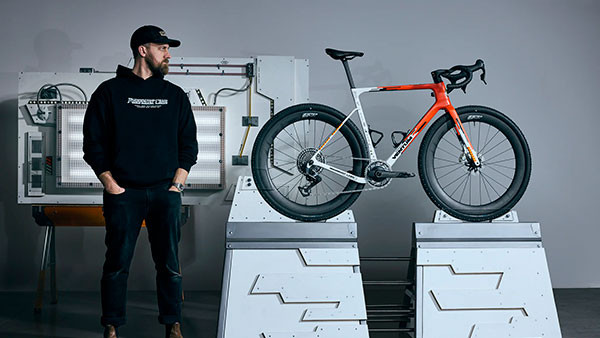
The bright orange streaks bleeding off the front of the bike are inspired by both a space capsule re-entering earth’s atmosphere and of a volcanic eruption, without obviously being either one. The black details on the white base color call back to NASA-esque graphics, while also nodding to the fields of black lava flow that surround Bend.
The black graphics on the seat tube pay homage to industrial equipment that are designed with utilitarian function in mind, whether warning or instruction. If a manufacturer wants a user to know about it, they print it right on the device itself, not buried in a user manual. On our rover, the nature of the graphics are generally cryptic but all have specific meanings. If you want a rundown of the full graphics package, track me down, I’ll gladly talk your ear off.
Yellow and orange caution stripes sit on the seat stays and under the bottom bracket to garner attention, like you may see on the backs of highway construction vehicles.
The colors: Magma, Dust, and Obsidian.
The gold leaf and hardware nod to space-fairing vehicles too, which often have used gold foil for heat protection. While extreme heat is not a specific concern in our use case, the gold does look absolutely sick.
The bright orange streaks bleeding off the front of the bike are inspired by both a space capsule re-entering earth’s atmosphere and of a volcanic eruption, without obviously being either one. The black details on the white base color call back to NASA-esque graphics, while also nodding to the fields of black lava flow that surround Bend.
Finishing the design was only the beginning. Enter Spectrum Paint Works, the artists who took his design from a 2D screen and translated it onto a 3D bike.
I flew out to their shop in Boulder, Colorado to document the full process of painting a complex custom design like this. David and Randy are the brains and muscle behind the operation at Spectrum.
The process looks something like this: a whole lot of sanding and surface prep, followed by meticulously laying vinyl masks, followed by paint. Then let it cure, then sand it. Then repeat all of that for each color, making sure to hit the re-coat windows to create strong adhesion.
Spectrum’s process includes hand sanding between coats, which facilitates a perfectly smooth finish at the end, with no bumps or ridges where colors meet. With a luxurious matte finish, it’s truly a perfect paint job.
I knew the bike needed a set in studio, a place to exist that broadens the design beyond the frame and gives it context. A rover needs a parking spot. I spent several weeks at the studio building backlit panels and a stand that you see here. The blessing and curse of having a lot of time to work on a project like this that I could have kept building forever. When is a project finished? Never, really, if you will give me more time to tinker.
French poet Paul Valéry reminds us that “a poem is never finished, only abandoned.” While I can’t say this project is now being published only because I “abandoned” it, the feeling that there could always be more to explore is always alive inside every project, especially ones that are so personal.
This is a story about process. Art is process. Fitness is process. High performance doesn’t happen through low reps. To remove process is to remove the soul of the outcome. Ask me how I feel about AI. My creative process is very hands on. While core elements of the set build were sketched out, a lot of ideas came from walking every single aisle of Home Depot looking for interesting items to use in creative ways. I was there for 5 hours on a Saturday.
Building the bike—finally!—after so long conceptualizing, planning, painting, and building sets, was to see the Rover finally come to life.
We could get lost in the sauce of specs (and believe me, I’d love nothing more), but suffice it to say, all the components are chosen to make for a perfect Bend gravel bike.
Let’s hit the highlights:
- Ventum GS1 gravel frame, size M/L
- Ventum CR5 integrated gravel cockpit
- SRAM Red XPLR 1x13 groupset
- ZIPP 303 XPLR SW wheels
- Schwalbe G-One RX Pro tires - 50mm width
- Better Bolts gold titanium hardware
- TIME XPRO road pedals. While I’m certainly not the first person to be choosing road pedals for gravel, road pedals work uniquely well in our dry and dusty environment where mud is not much of a concern.
- Arundel Mandible carbon bottle cages
- Specialized Power Pro with Mirror saddle
I’m lucky to live a life of blurred lines between work and play. The Rover is representative of that; I work with bikes but also play with bikes. Cycling is deeply rooted in the client work at Moondust Labs, but this bike is personal. A vehicle for discovering new ideas, new places, new horizons.
A rover for exploring creative endeavors in the high desert.
Caleb Kerr is a commercial photographer and creator of Moondust Labs, a visual arts studio in Bend Oregon USA. To learn more about Moondust Labs, please visit www.moondustlabs.com or @moondustlabs on Instagram.